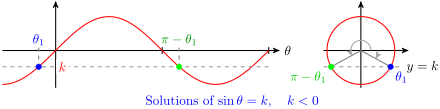
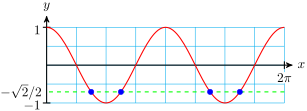
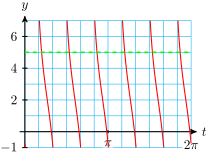
We expect to find four solutions. Let \(\theta = 2x+1.5\text{,}\) and use a calculator to find two solutions of \(\sin (\theta) = -0.3\text{.}\) The solutions, rounded to three decimal places, are
\begin{equation*}
\theta_{1}=\sin^{-1}(-0.3)=-0.3047 ~~ \text{and} ~~ \theta_{2}=\pi - \sin^{-1}(-0.3)=3.4463
\end{equation*}
Because \(\theta\) is not between \(0\) and \(2\pi\text{,}\) we find a coterminal angle,
\begin{equation*}
\theta_{1}=\sin^{-1}(-0.3)+2\pi = 5.9785
\end{equation*}
Next we replace \(\theta\) by \(2x+1.5\) to find two of the solutions of the original equation:
\begin{align*}
2x+1.5 \amp = 3.4463 \amp\amp \text{and} \amp 2x+1.5 \amp = 5.9785\\
x_{1} \amp = 0.9731 \amp\amp \amp x_{2}\amp =2.2392
\end{align*}
Finally, because the period of the function \(f(x)=\sin (2x+1.5)\) is \(\pi\text{,}\) we find the other two solutions by adding \(\pi\) to the first two solutions, to get
\begin{align*}
x_{3}\amp=0.9731+\pi = 4.1147\\
x_{4}\amp=2.2392+\pi=5.3808
\end{align*}
Rounded to hundredths, the four solutions are \(0.97, 2.24, 4.11,\) and \(5.38\text{.}\)