Subsection Horizontal and Vertical Lines
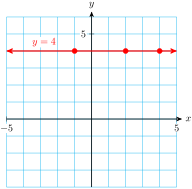
Two special cases of linear equations are worth noting. First, an equation such as \(y=4\) can be thought of as an equation in two variables,
\begin{equation*}
0x+y=4
\end{equation*}
For each value of \(x\text{,}\) this equation assigns the value \(\alert{4}\) to \(y\text{.}\) Thus, any ordered pair of the form \((x,4)\) is a solution of the equation. For example,
\begin{equation*}
(-1,\alert{4}),~~(2,\alert{4})~~\text{and}~~(4,\alert{4})
\end{equation*}
are all solutions of the equation. If we draw a straight line through these points, we obtain the horizontal line shown at left below.
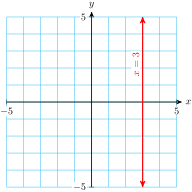
The other special case of a linear equation is of the type \(x=3\text{,}\) or
\begin{equation*}
x+0y=3
\end{equation*}
Here, only one value is permissible for \(x\text{,}\) namely \(\alert{3}\text{,}\) while any value may be assigned to \(y\text{.}\) Any ordered pair of the form \((3,y)\) is a solution of this equation. If we choose two solutions, say \((\alert{3},1)\) and \((\alert{3},3)\text{,}\) and draw a straight line through these two points, we have the vertical line shown at right above. In general, we have the following results.
The graph of
\(~~x=k~~\) (
\(k\) a constant) is a vertical line.
The graph of
\(~~y=k~~\) (
\(k\) a constant) is a horizontal line.
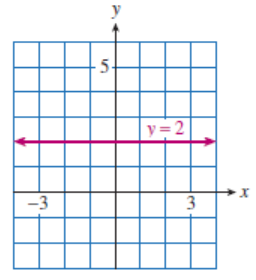
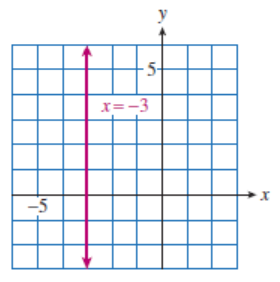
Example A.108.
-
Graph \(~y=2\text{.}\)
-
Graph \(~x=-3\text{.}\)
Now let’s compute the slopes of the two lines in the previous example. Choose two points on the graph of \(y=2\text{,}\) say \((-5,2)\) and \((4,2)\text{.}\) Use these points to compute the slope.
\begin{equation*}
m=\dfrac{y_2-y_1}{x_2-x_1}=\dfrac{2-2}{4-(-5)}=\dfrac{0}{9}=0
\end{equation*}
The slope of the horizontal line \(y=2\) is zero. In fact, the slope of any horizontal line is zero, because the \(y\) -coordinates of all the points on the line are equal. Thus
\begin{equation*}
m=\dfrac{y_2-y_1}{x_2-x_1}=\dfrac{0}{x_2-x_1}=0
\end{equation*}
On a vertical line, the \(x\)-coordinates of all the points are equal. For example, two points on the line \(x=-3\) are \((-3,1)\) and \((-3,6)\text{.}\) Using these points to compute the slope, we find
\begin{equation*}
m=\dfrac{y_2-y_1}{x_2-x_1}=\dfrac{6-1}{-3-(-3)}=\dfrac{5}{0}
\end{equation*}
which is undefined. The slope of any vertical line is undefined because the expression \(x_2-x_1\) equals zero.
The slope of a horizontal line is zero.
The slope of a vertical line is undefined.
Subsection Parallel and Perpendicular Lines
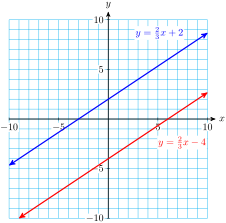
Consider the graphs of the equations
\begin{gather*}
y=\dfrac{2}{3}x-4\\
y=\dfrac{2}{3}x+2
\end{gather*}
shown below.
The lines have the same slope,
\(\dfrac{2}{3}\text{,}\) but different
\(y\)-intercepts. Because slope measures the steepness or inclination of a line, lines with the same slope are
parallel.
Two lines with slopes
\(m_1\) and
\(m_2\) are
parallel if and only if
\(m_1=m_2\text{.}\)
Example A.109.
Are the graphs of the equations
\(3x+6y=6\) and
\(y=-\dfrac{1}{2}x+5\) parallel?
Solution.
The lines are parallel if their slopes are equal. We can find the slope of the first line by putting its equation into slope-intercept form. We solve for \(y\text{:}\)
\begin{equation*}
\begin{aligned}[t]
3x+6y \amp = 6 \amp \amp \blert{\text{Subtract}~ 3x~ \text{from both sides.}}\\
6y \amp = -3x + 6 \amp \amp \blert{\text{Divide both sides by}~6.}\\
y \amp = \dfrac{-3x}{6} + \dfrac{6}{6} \amp \amp \blert{\text{Simplify.}}\\
y = \amp = -\dfrac{1}{2}x + 1\\
\end{aligned}
\end{equation*}
The slope of the first line is \(m_1=-\dfrac{1}{2}\text{.}\) The equation of the second line is already in slope-intercept form, and its slope is \(m_2=-\dfrac{1}{2}\text{.}\) Thus, \(m_1=m_2\text{,}\) so the lines are parallel.
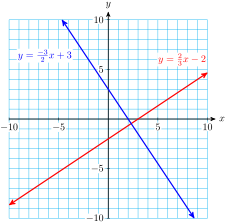
Now consider the graphs of the equations
\begin{gather*}
y=\dfrac{2}{3}x-2\\
y=-\dfrac{3}{2}x+3
\end{gather*}
shown below.
The lines appear to be perpendicular. The relationship between the slopes of perpendicular lines is not as easy to see as the relationship for parallel lines. However, for this example, \(m_1=\dfrac{2}{3}\) and \(m_2=-\dfrac{3}{2}\text{.}\) Note that
\begin{equation*}
m_2=-\dfrac{3}{2} = \dfrac{-1}{\dfrac{2}{3}} = \dfrac{-1}{m_1}
\end{equation*}
This relationship holds for any two perpendicular lines with slopes \(m_1\) and \(m_2\text{,}\) as long as \(m_1 \not= 0\) and \(m_2 \not= 0\text{.}\)
Two lines with slopes \(m_1\) and \(m_2\) are perpendicular if
\begin{equation*}
m_2=\dfrac{-1}{m_1}\text{.}
\end{equation*}
We say that
\(m_2\) is the
negative reciprocal of
\(m_1\text{.}\)
Example A.110.
Are the graphs of
\(3x-5y=5\) and
\(2y=\dfrac{10}{3}x+3\) perpendicular?
Solution.
We find the slope of each line by putting the equations into slope-intercept form. For the first line,
\begin{equation*}
\begin{aligned}[t]
5y \amp = 3x-5 \amp \amp \blert{\text{Divide both sides by}~ 5.}\\
y \amp = \dfrac{3}{5}x - 1\\
\end{aligned}
\end{equation*}
so \(m_1=\dfrac{3}{5}\text{.}\) For the second line, \(y=\dfrac{5}{3}x+\dfrac{3}{2}\text{,}\) so \(m_2=\dfrac{5}{3}\text{.}\) Now, the negative reciprocal of \(m_1\) is
\begin{equation*}
\dfrac{-1}{m_1}=\dfrac{-1}{\dfrac{3}{5}}=\dfrac{-5}{3}
\end{equation*}
but \(m_2=\dfrac{5}{3}\text{.}\) Thus, \(m_2 \not= \dfrac{-1}{m_1}\text{,}\) so the lines are not perpendicular.
Subsection Applications to Geometry
These relationships for the slopes of parallel and perpendicular lines can help us solve numerous geometric problems.
Example A.111.
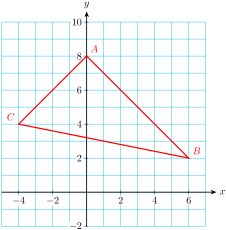
Show that the triangle with vertices
\(A(0,8),~B(6,2),~\) and
\(C(-4,4)\) shown below is a right triangle.
Solution.
We will show that two of the sides of the triangle are perpendicular. The line segment \(\overline{AB}\) has slope
\begin{equation*}
m_1 = \dfrac{2-8}{6-0} = \dfrac{-6}{6} = -1
\end{equation*}
and the line segment \(\overline{AC}\) has slope
\begin{equation*}
m_2 = \dfrac{4-8}{-4-0} = \dfrac{-4}{-4} = 1
\end{equation*}
Because
\begin{equation*}
\dfrac{-1}{m_1} = \dfrac{-1}{-1} = 1 = m_2,
\end{equation*}
the sides \(\overline{AB}\) and \(\overline{AC}\) are perpendicular, and the triangle is a right triangle.
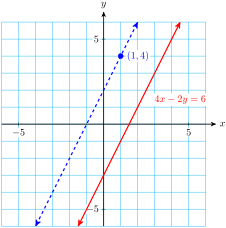
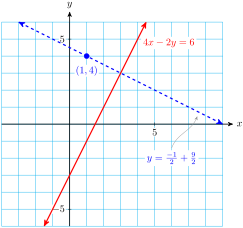
Consider the graph of
\(4x-2y=6\) shown below.
Can we find the equation of the line that is parallel to this line, but passes through the point
\((1,4)\text{?}\) If we can find the slope of the desired line, we can use the slope-intercept formula to find its equation.
Now because the line we want is parallel to the given line, they must have the same slope. To find the slope of the given line, we write its equation in slope-intercept form:
\begin{equation*}
\begin{aligned}[t]
4x-2y \amp = 6 \amp \amp \blert{\text{Subtract}~4x~\text{from both sides.}}\\
-2y \amp = -4x+6 \amp \amp\ \blert{\text{Divide both sides by}~-2.}\\
y \amp = 2x-3\\
\end{aligned}
\end{equation*}
The slope of the given line is \(2\text{.}\) Because the unknown line is parallel to this line, its slope is also \(2\text{.}\) Now we know the slope of the desired line, \(m=2\text{,}\) and one point on the line, \((1,4)\text{.}\) Substituting these values into the point-slope formula will give us the equation.
\begin{equation*}
\begin{aligned}[t]
y-y_1 \amp = m(x-x_1)\\
y-\alert{4} \amp = \alert{2}(x-\alert{1}) \amp \amp \blert{\text{Apply the distributive law.}}\\
y-4\amp = 2x-2 \amp \amp \blert{\text{Add 4 to both sides.}}\\
y\amp = 2x+2
\end{aligned}
\end{equation*}
Example A.112.
Find an equation for the line that passes through the point
\((1,4)\) and is perpendicular to the line
\(4x-2y=6\text{.}\)
Solution.
We follow the same strategy as in the discussion above: First find the slope of the desired line, then use the point-slope formula to write its equation.
The line we want is perpendicular to the given line, so its slope is the negative reciprocal of \(m_1=2\text{,}\) the slope of the given line. Thus
\begin{equation*}
m_2 = \dfrac{-1}{m_1} = \dfrac{-1}{2}
\end{equation*}
Now we use the point-slope formula with \(m_2= \dfrac{-1}{2}\) and \((x_1,y_1)=(1,4)\text{.}\)
\begin{equation*}
\begin{aligned}[t]
y-y_1 \amp = m(x-x_1)\\
y-\alert{4} \amp = \alert{\dfrac{-1}{2}}(x-\alert{1}) \amp \amp \blert{\text{Apply the distributive law.}}\\
y-4\amp = \dfrac{-1}{2}x+\dfrac{1}{2} \amp \amp \blert{\text{Add 4 to both sides.}}\\
y\amp = \dfrac{-1}{2}x+\dfrac{9}{2} \amp \amp \blert{\dfrac{1}{2}+4 = \dfrac{1}{2}+\dfrac{8}{2}=\dfrac{9}{2}}\\
\end{aligned}
\end{equation*}
The given line and the perpendicular line are shown below.