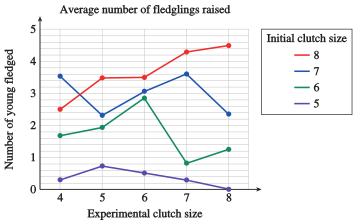
The number of eggs (clutch size) that a bird lays varies greatly. Is there an optimal clutch size for birds of a given species, or does it depend on the individual bird?
In 1980, biologists in Sweden conducted an experiment on magpies as follows: They reduced or enlarged the natural clutch size by adding or removing eggs from the nests. They then computed the average number of fledglings successfully raised by the parent birds in each case.
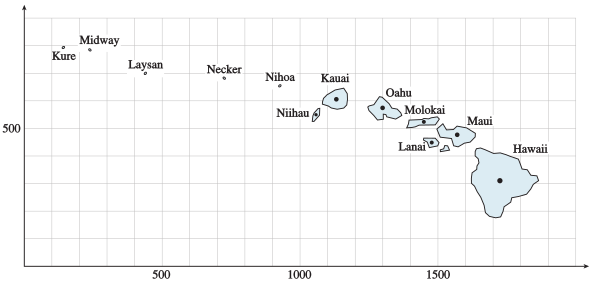
The Big Island of Hawaii is the last island in a chain of islands and submarine mountain peaks that stretch almost 6000 kilometers across the Pacific Ocean. All are extinct volcanoes except for the Big Island itself, which is still active.
The ages of the extinct peaks are roughly proportional to their distance from the Big Island. Geologists believe that the volcanic islands were formed as the tectonic plate drifted across a hot spot in the Earth’s mantle. The figure shows a map of the islands, scaled in kilometers. (Source: Open University, 1998)
The tables give the ages of the islands, in millions of years. Estimate the distance from each island to the Big Island, along a straight-line path through their centers. Fill in the third row of the tables.
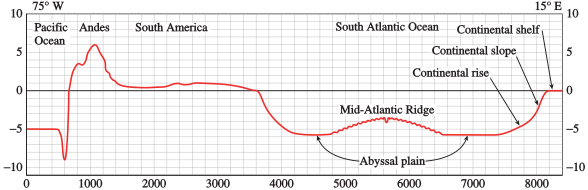
The graph shows a cross section of Earth’s surface along an east-west line from the coast of Africa through the Atlantic Ocean to South America. Both axes are scaled in kilometers. Use the figure to estimate the distances in this problem. (Source: Open University, 1998)
What is the highest land elevation shown in the figure? What is the lowest ocean depth shown? Give the horizontal coordinates of these two points, in kilometers west of the \(75\degree\)W longitude line.
How deep is the Atlantic Ocean directly above the crest of the Mid-Atlantic Ridge? How deep is the ocean above the abyssal plain on either side of the ridge?
Estimate the slopes of the continental shelf, the continental slope, and the continental rise. Use the coordinates of the points indicated on the figure
The Mid-Atlantic Ridge is a mountain range on the sea floor beneath the Atlantic Ocean. It was discovered in the late nineteenth century during the laying of transatlantic telephone cables. The ridge is volcanic, and the ocean floor is moving away from the ridge on either side.
Geologists have estimated the speed of this sea-floor spreading by recording the age of the rocks on the sea floor and their distance from the ridge. (The age of the rocks is calculated by measuring their magnetic polarity. At known intervals over the last four million years, the Earth reversed its polarity, and this information is encoded in the rocks.) (Source: Open University, 1998)
According to the table, rocks that are \(0.78\) million years old have moved \(17\) kilometers from the ridge. What was the speed of spreading over the past \(0.78\) million years? (This is the rate of spreading closest to the ridge.)
The slope you calculated in part (c) represents the average spreading rate over the past \(3.58\) million years. Is the average rate greater or smaller than the rate of spreading closest to the ridge?
Naismith’s rule is used by runners and walkers to estimate journey times in hilly terrain. In 1892, Naismith wrote in the Scottish Mountaineering Club Journal that a person “in fair condition should allow for easy expeditions an hour for every three miles on the map, with an additional hour for every 2000 feet of ascent.” (Source: Scarf, 1998)
According to Naismith, one unit of ascent requires the same time as how many units of horizontal travel? (Convert miles to feet.) This is called Naismith’s number. Round your answer to one decimal place
Empirical investigations have improved Naismith’s number (see Project 1.169) to \(8.0\) for men and \(9.5\) for women. Part of the Karrimor International Mountain Marathon in the Arrochar Alps in Scotland has a choice of two routes. Route A is \(1.75\) kilometers long with a \(240\)-meter climb, and route B is \(3.25\) kilometers long with a \(90\)-meter climb. (Source: Scarf, 1998)