In 1772, the astronomer Johann Bode promoted a formula for the orbital radii of the six planets known at the time. This formula calculated the orbital radius, \(r\text{,}\) as a function of the planet’s position, \(n\text{,}\) in line from the Sun. (Source: Bolton, 1974)
Evaluate Bode’s law,
\begin{equation*}
r (n) = 0.4 + 0.3(2^{n-1})
\end{equation*}
for the values in the table. (Use a large negative number, such as \(n = -100\text{,}\) to approximate \(r (-\infty)\text{.}\))
How do the values of \(r(n)\) compare with the actual orbital radii of the planets shown in the table? (The radii are given in astronomical units (AU). One AU is the distance from the Earth to the Sun, about \(149.6\times 10^6\) kilometers.) Assign values of \(n\) to each of the planets so that they conform to Bode’s law.
In 1781, William Herschel discovered the planet Uranus at a distance of \(19.18\) AU from the Sun. If \(n = 7\) for Uranus, what does Bode’s law predict for the orbital radius of Uranus?
None of the planets’ orbital radii corresponds to \(n = 2\) in Bode’s law. However, in 1801 the first of a group of asteroids between the orbits of Mars and Jupiter was discovered. The asteroids have orbital radii between \(2.5\) and \(3.0\) AU. If we consider the asteroids as one planet, what orbital radius does Bode’s law predict?
In 1846, Neptune was discovered \(30.6\) AU from the Sun, and Pluto was discovered in 1930 \(39.4\) AU from the Sun. What orbital radii does Bode’s law predict for these planets?
In 1665, there was an outbreak of the plague in London. The table shows the number of people who died of plague during each week of the summer that year. (Source: Bolton, 1974)
Scale horizontal and vertical axes for the entire data set, but plot only the data for the first 8 weeks of the epidemic, from May 9 through July 4. On the same axes, graph the function \(f (x) = 2.18 (1.83)^x\text{.}\)
Add data points for July 11 through October 10 to your graph. Describe the progress of the epidemic relative to the function \(f\) and offer an explanation.
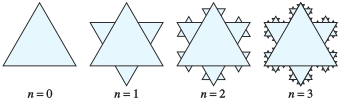
The Koch snowflake is an example of a fractal. It is named in honor of the Swiss mathematician Niels Fabian Helge von Koch (1870–1924). Here is how to construct a Koch snowflake:
Draw an equilateral triangle with sides of length \(1\) unit. This is stage \(n = 0\text{.}\)
Divide each side into \(3\) equal segments and draw a smaller equilateral triangle on each middle segment, as shown in the figure. The new figure (stage \(n = 1\)) is a \(6\)-pointed star with \(12\) sides.
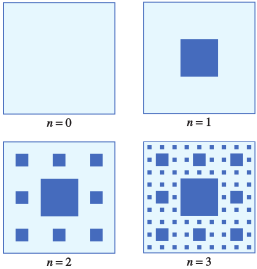
The Sierpinski carpet is another fractal. It is named for the Polish mathematician Waclaw Sierpinski (1882–1969). Here is how to build a Sierpinski carpet:
Start with a unit square (sides of length 1 unit.)
For stage \(n = 1\text{,}\) trisect each side and partition the square into 9 smaller squares. Remove the center square, leaving a hole surrounded by 8 squares, as shown in the figure.
The order of a stream or river is a measure of its relative size. A first-order stream is the smallest, one that has no tributaries. Second-order streams have only first-order streams as tributaries. Third-order streams may have first- and second-order streams as tributaries, and so on. The Mississippi River is an example of a tenth-order stream, and the Columbia River is ninth order.
Both the number of streams of a given order and their average length are exponential functions of their order. In this problem, we consider all streams in the United States. (Source: Leopold, Luna, Gordon, and Miller, 1992)
Using the given values, find a function \(N(x) = ab^{x-1}\) for the number of streams of a given order.
Related species living in the same area often evolve in different sizes to minimize competition for food and habitat. Here are the masses of eight species of fruit pigeon found in New Guinea, ranked from smallest to largest. (Source: Burton, 1998)
Compute the ratios of the masses of successive sizes of fruit pigeons. Are the ratios approximately constant? What does this information tell you about your answer to part (a)?
Suppose you deposit \(\$100\) at the end of every \(6\) months into an account that pays \(4\%\) compounded annually. How much money will be in the account at the end of \(3\) years?
During the \(3\) years, you will make \(6\) deposits. Use the formula
\begin{equation*}
F = P(1 + \dfrac{r}{n})^{nt}
\end{equation*}
to write an expression for the future value (principal plus interest) of each deposit. (Do not evaluate the expression!)
You could find \(S\) by working out all the terms and adding them up, but what if there were \(100\) terms, or more? We will use a trick to find the sum in an easier way. Multiply both sides of the equation in part (b) by \(1.02\text{.}\) (Use the distributive law on the right side!)
Finally, solve for \(S\text{.}\) If you factor \(100\) from the numerator on the right side, your expression should look a lot like the formula for the future value of an annuity. (To help you see this, note that, for this example, \(\dfrac{r}{n}=\text{?} \) and \(nt=\text{?} \))
You would like to set up an account that pays \(4\%\) interest compounded semiannually so that you can withdraw \(\$100\) at the end of every \(6\) months for the next \(3\) years. How much should you deposit now?
During the \(3\) years, you will make \(6\) withdrawals. Use the formula
\begin{equation*}
P = A(1 + \dfrac{r}{n})^{-nt}
\end{equation*}
to write an expression for the present value of those withdrawals. (Do not evaluate the expression!)
We will use a trick to evaluate the sum. Multiply both sides of the equation in part (b) by \(1.02\text{.}\) (Use the distributive law on the right side!)
Finally, solve for \(S\text{.}\) If you factor \(100\) from the numerator on the right side, your expression should look a lot like the formula for the present value of an annuity. (To help you see this, note that, for this example, \(\dfrac{r}{n}=\text{?} \) and \(nt=\text{?} \))