Here is a simplified model for the growth of a population of fish. The size of the stock is measured by the combined weight of the population, called the biomass. The population begins with two fish, a male and a female, each weighing one unit. The fish grow one unit of mass each year, and die after their third year. Every pair of fish gives birth to a new pair of unit-mass fish each year.
Let \(A_n,~B_n,\) and \(C_n\) represent the number of one-unit, two-unit, and three-unit fish in the population in year \(n\text{,}\) and let \(S_n\) be the total biomass of the stock in year \(n\text{.}\) Complete the table.
Write a recursive formula for \(S_n\) in terms of \(A_n,~B_n,\) and \(C_n\text{.}\) Can you express \(S_n\) using only terms of the sequence \(A_n\text{?}\)
The model in the previous project is only useful for a limited time, because the fish population cannot continue to grow indefinitely. The model described below is called a logistic model. Suppose a fishery starts with a stock of 20 fish, so \(S_0 = 20\text{.}\) The growth \(G_n\) of the population in year \(n\) is given by
Rewrite the sum by reversing the order of the terms on the right side of the equation and add the result "columnwise" to the equation above. What is the sum of the two numbers in any one column on the right side?
From part (a) you know how many columns there are. Based on that number and your answer to part (b), write an expression for \(2S\) and solve for \(S\text{.}\)
In this problem we will find a formula for the sum of an arithmetic series when we are given the first term \(F\) the last term \(L\text{,}\) the common difference \(d\) and the number of terms \(N\text{.}\)
Rewrite the sum by reversing the order of the terms on the right side of the equation and add the result "columnwise" to the equation above. What is the sum of the two numbers in any one column on the right side?
Use your answer from part (c) to write a formula for the sum of an arithmetic series when we are given the first term \(F\) the last term \(L\text{,}\) the common difference \(d\) and the number of terms \(N\text{.}\)
Subtract your last equation from the equation for \(A\) given above, simplify, and factor out \(A\) on the left side of the equation and \(a\) on the right. What is the result?
In this problem we will find a formula for the sum of an arithmetic series when we are given the first term \(F\text{,}\) the common difference \(d\text{,}\) and the number of terms \(N\text{,}\) but we are not given the last term.
Because the common difference is \(d\text{,}\) when we add \(d\) to a term we get the next term. The first term is \(F\text{,}\) so the second term is \(F+d\text{,}\) and the third term is \(F+2d\text{.}\) How can you express the third term? How can you express the ninth term?
Now you know the first term \(F\text{,}\) the last term \(L\text{,}\) the common difference \(d\text{,}\) and the number of terms \(N\text{.}\) Find a formula for the value of the series.
Subtract your last equation from the equation for \(A\) given above, simplify, and factor out \(A\) on the left side of the equation and \(a\) on the right. What is the result?
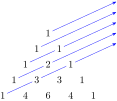
Now add entries of Pascal’s triangle along the diagonal lines indicated below. Fill in two more rows of Pascal’s triangle and find two more diagonal sums.
The binomial coefficient \(~_nC_k~\) also gives the number of different ways you can choose \(k\) distinct items from a set of \(n\) items. Finding these numbers is important in determining the probability that certain events will occur.
Find the number of different choices you can make for a four-flavor ice cream sundae if there are six flavors to choose from. (Caution: When you are deciding which entry in the row corresponds to \(k=4\text{,}\) remember that the left-most entry corresponds to \(k=0\text{.}\))
(Hint: This is the sum of all the binomial coefficients in the expansion of \((a+b)^n\text{.}\) What did you learn in Step 2 about the sum of the terms in a row of Pascal’s triangle?)