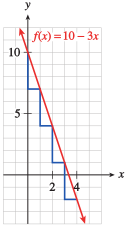
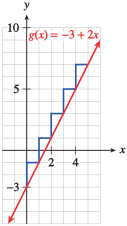
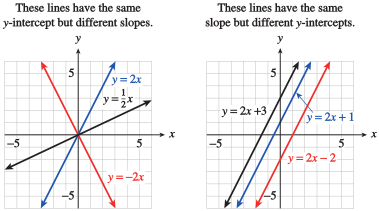
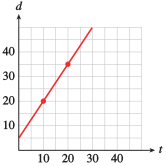
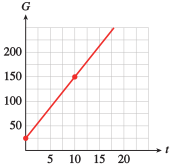
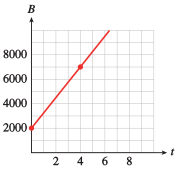
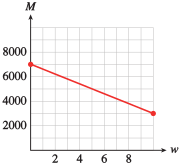
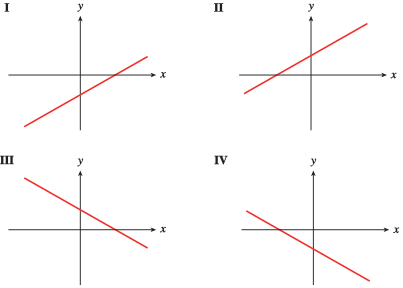
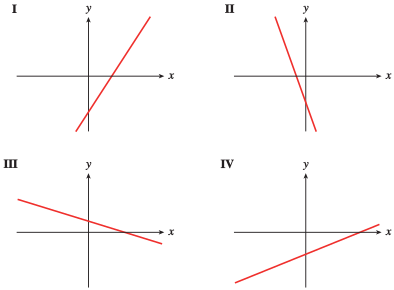
The starting value, or the value of \(y\) at \(x = 0\text{,}\) is the \(y\)-intercept of the graph, and the rate of change is the slope of the graph. Thus, we can write the equation of a line as
\begin{equation*}
\blert{f (x) = b + mx}
\end{equation*}
where the constant term, \(b\text{,}\) is the \(y\)-intercept of the line, and \(m\text{,}\) the coefficient of \(x\text{,}\) is the slope of the line. This form for the equation of a line is called the slope-intercept form.
For each graph, the coefficient of \(x\) is a scale factor that tells us how many units \(y\) changes for \(1\) unit increase in \(x\text{.}\) But that is exactly what the slope tells us about a line.
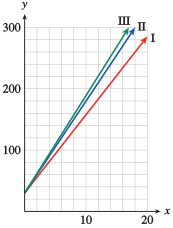
Francine pays the same initial amount, $30 for the modem, under each plan. The monthly fee is the rate of change of her total cost, in dollars per month. We can write a formula for her cost under each plan.
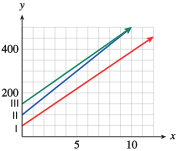
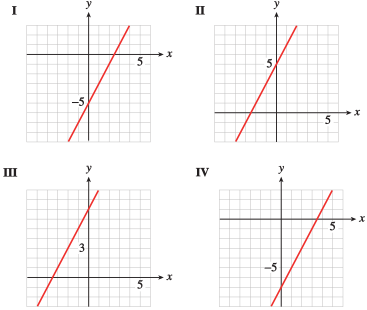
The graphs of these three functions all have the same \(y\)-intercept, but their slopes are determined by the monthly fees. The steepest graph, III, is the one with the largest monthly fee, peoplepc. ISP.com, which has the lowest monthly fee, has the least steep graph, I.
Delbert decides to use DSL for his Internet service. Earthlink charges a $99 activation fee and $39.95 per month, DigitalRain charges $50 for activation and $34.95 per month, and FreeAmerica charges $149 for activation and $34.95 per month.
In the equation \(~f (x) = b + mx\text{,}\) we call \(m\) and \(b\) parameters. Their values are fixed for any particular linear equation; for example, in the equation \(y = 3+2x\text{,}\)\(b=3\) and \(m=2\text{,}\) and the variables are \(x\) and \(y\text{.}\) By changing the values of \(m\) and \(b\text{,}\) we can write the equation for any line except a vertical line. The collection of all linear functions \(f(x) = b + mx\) is called a two-parameter family of functions.
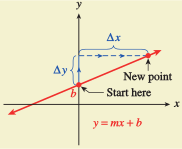
Look again at the lines in the previous figure: There is only one line that has a given slope and passes through a particular point. That is, the values of \(m\) and \(b\) determine the particular line. The value of \(b\) gives us a starting point, and the value of \(m\) tells us which direction to go to plot a second point. Thus, we can graph a line given in slope-intercept form without having to make a table of values.
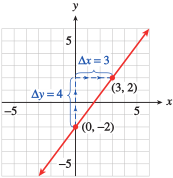
We see that the slope of the line is \(m = \dfrac{4}{3}\) and its \(y\)-intercept is \(b = -2\text{.}\) We begin by plotting the \(y\)-intercept, \((0, -2)\text{.}\) We then use the slope to find another point on the line. We have
\begin{equation*}
m = \frac{\Delta y}{\Delta x}=\frac{4}{3}
\end{equation*}
so starting at \((0, -2)\text{,}\) we move \(4\) units in the \(y\)-direction and \(3\) units in the \(x\)-direction, to arrive at the point \((3, 2)\text{.}\) Finally, we draw the line through these two points.
The slope of a line is a ratio and can be written in many equivalent ways. In Example 1.130, the slope is equal to \(\dfrac{8}{6}\text{,}\)\(\dfrac{12}{9}\text{,}\) and \(\dfrac{-4}{-3}\text{.}\) We can use any of these fractions to locate a third point on the line as a check. If we use \(m = \dfrac{\Delta y}{\Delta x}= \dfrac{-4}{-3}\text{,}\) we move down \(4\) units and left \(3\) units from the \(y\)-intercept to find the point \((-3, -6)\) on the line.
Use the definition of slope to find a second point on the line: Starting at the \(y\)-intercept, move \(\Delta y\) units in the \(y\)-direction and \(\Delta x\) units in the \(x\)-direction. Plot a second point at this location.
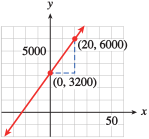
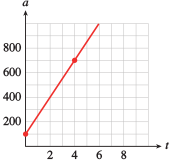
We can also use the slope-intercept form to find the equation of a line from its graph. First, we note the value of the \(y\)-intercept from the graph, and then we calculate the slope using two convenient points.
The line crosses the \(y\)-axis at the point \((0, 3200)\text{,}\) so the \(y\)-intercept is \(3200\text{.}\) To calculate the slope of the line, we locate another point, say \((20, 6000)\text{,}\) and compute:
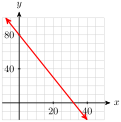
We can read the \(y\)-intercept from the graph, so \(b = 80\text{.}\) Another point is \((20,30)\text{,}\) and from those two points we can compute the slope, \(m =\dfrac{-5}{2}\text{.}\) So the slope-intercept form for the equation of the line is
\begin{equation*}
y = 80 - \dfrac{5}{2}x
\end{equation*}
We can find the equation for a line if we know its slope and \(y\)-intercept. What if we do not know the \(y\)-intercept, but instead know some other point on the line? There is only one line that passes through a given point and has a given slope, so we should be able to find its equation.
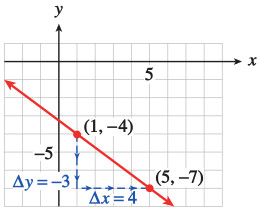
For example, we can graph the line of slope \(\dfrac{-3}{4}\) that passes through the point \((1, -4)\text{.}\) We first plot the given point, \((1, -4)\text{,}\) as shown in the figure below.
Then we use the slope to find another point on the line. The slope is
\begin{equation*}
m =\frac{-3}{4}= \frac{\Delta y}{\Delta x}
\end{equation*}
so we move down \(3\) units and then \(4\) units to the right, starting from \((1, -4)\text{.}\) This brings us to the point \((5, -7)\text{.}\) We can then draw the line through these two points.
\begin{equation*}
m = \frac{y_2 - y_1}{x_2 - x_1}
\end{equation*}
We substitute \(\dfrac{-3}{4}\) for the slope, \(m\text{,}\) and \((1, -4)\) for \((x_1, y_1)\text{.}\) For the second point, \((x_2, y_2)\text{,}\) we use the variable point \((x, y)\text{.}\) Substituting these values into the slope formula gives us
When we use the slope formula in this way to find the equation of a line, we substitute a variable point \((x, y)\) for the second point. This version of the formula,
\begin{equation*}
m = \frac{y - y_1}{x - x_1}
\end{equation*}
is called the point-slope form for a linear equation. It is sometimes stated in another form obtained by clearing the fraction to get
\begin{equation*}
\begin{aligned}[t]
\alert{(x-x_1)}m\amp
=\frac{y -y_1}{x - x_1}\alert{(x-x_1)} \amp\amp
\blert{\text{Multiply both sides by }(x - x_1)}\\
(x - x_1) m\amp=y-y_1 \amp\amp\blert{\text{Clear fractions and solve for }y\text{.}}\\
y\amp=y_1+m(x-x_1)
\end{aligned}
\end{equation*}
Under a proposed graduated income tax system, single taxpayers would owe $1500 plus 20% of the amount of their income over $13,000. (For example, if your income is $18,000, you would pay $1500 plus 20% of $5000.)
Complete the table of values for the tax, \(T\text{,}\) on various incomes, \(I\text{.}\)
On an income of \(I\text{,}\) the amount of income over $13,000 is \(I - \$13,000\text{,}\) so you would pay $1500 plus 20% of \(I - 13,000\text{,}\) or
\begin{equation*}
T = 1500 + 0.20 (I - 13,000)
\end{equation*}
A healthy weight for a young woman of average height, 64 inches, is 120 pounds. To calculate a healthy weight for a woman taller than 64 inches, add 5 pounds for each inch of height over 64.
Write a linear equation in point-slope form for the healthy weight, \(W\text{,}\) for a woman of height, \(H\text{,}\) in inches.
The initial value of a linear function and the \(y\)-intercept of its graph are given by \(b\text{.}\) The rate of change of the function and the slope of its graph are given by \(m\text{.}\)
If the temperature on the ground is \(70\degree\) Fahrenheit, the formula \(T = 70 - \dfrac{3}{820}h\) defines a function that gives the temperature at an altitude of \(h\) feet.
What is the temperature at an altitude of \(4100\) feet?
In England, oven cooking temperatures are often given as Gas Marks rather than degrees Fahrenheit. The table shows the equivalent oven temperatures for various Gas Marks.
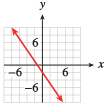
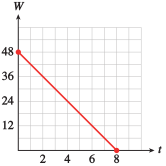
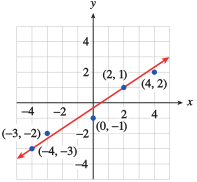
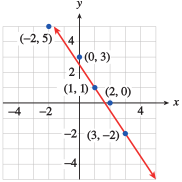
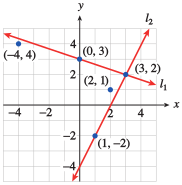
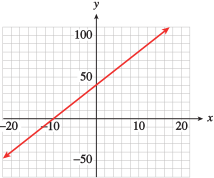
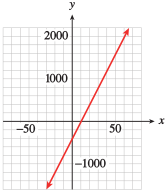
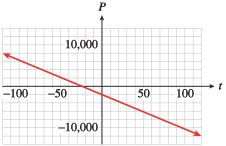
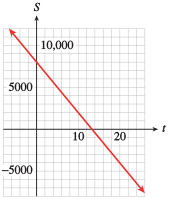
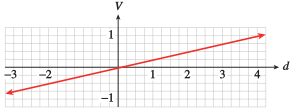
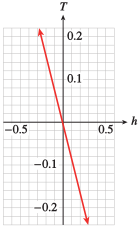
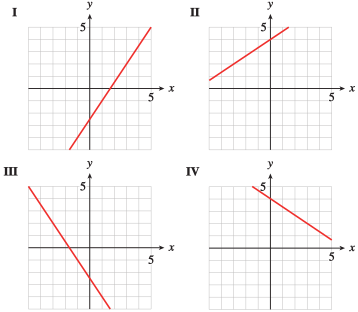
Estimate the slope and vertical intercept of each line. (Hint: To calculate the slope, find two points on the graph that lie on the intersection of grid lines.)
Draw a set of coordinate axes with a square grid (i.e., with units the same size in both directions). Sketch four lines through the point \((0, 4)\) with the following slopes:
\begin{equation*}
m = 3, ~~~ m = -3,~~~ m = \frac{1}{3}, ~~~ m =\frac{-1}{3}
\end{equation*}
The boiling point of water changes with altitude and is approximated by the formula
\begin{equation*}
B = f (h) = 212 - 0.0018h
\end{equation*}
where \(B\) is in degrees and \(h\) is in feet. State the slope and vertical intercept of the graph, including units, and explain their meaning in this context.