In the last section, we considered powers of the form \(a^{1/n}\text{,}\) such as \(x^{1/3}\) and \(x^{-1/4}\text{,}\) and saw that \(a^{1/n}\) is equivalent to the root \(\sqrt[n]{a}\text{.}\) What about other fractional exponents? What meaning can we attach to a power of the form \(a^{m /n}\text{?}\)
Consider the power \(x^{3/2}\text{.}\) Notice that the exponent \(\dfrac{3}{2}= 3(\dfrac{1}{2})\text{,}\) and thus by the third law of exponents, we can write
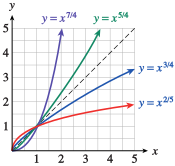
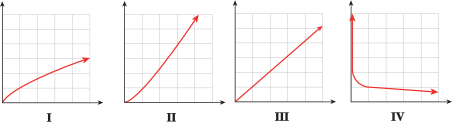
The graphs of power functions \(y = x^{m/n}\text{,}\) where \(m/n\) is positive, are all increasing for \(x\ge 0\text{.}\) If \(m/n \gt 1\text{,}\) the graph is concave up. If \(0 \lt m/n \lt 1\text{,}\) the graph is concave down. Some examples are shown below.
Perhaps the single most useful piece of information a scientist can have about an animal is its metabolic rate. The metabolic rate is the amount of energy the animal uses per unit of time for its usual activities, including locomotion, growth, and reproduction. The basal metabolic rate, or BMR, sometimes called the resting metabolic rate, is the minimum amount of energy the animal can expend in order to survive.
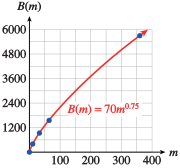
If energy consumption were proportional to body weight, the graph would be a straight line. But because the exponent in Kleiber’s rule, \(\dfrac{3}{4}\text{,}\) is less than \(1\text{,}\) the graph is concave down, or bends downward. Therefore, larger species eat less than smaller ones, relative to their body weight.
In Example 3.87 we saw that large animals eat less than smaller ones, relative to their body weight. This is because the scaling exponent in Kleiber’s rule is less than \(1\text{.}\) For example, let \(s\) represent the mass of a squirrel. The mass of a moose is then \(600s\text{,}\) and its metabolic rate is
In a famous experiment in the 1960s, an elephant was given LSD. The dose was determined from a previous experiment in which a \(2.6\)-kg cat was given \(0.26\) gram of LSD. Because the elephant weighed \(2970\) kg, the experimenters used a direct proportion to calculate the dose for the elephant:
If the experimenters had taken into account the scaling exponent of \(0.75\) in metabolic rate, they would have used a smaller dose. Because the elephant weighs \(\dfrac{2970}{2.6}\) , or about \(1142\) times as much as the cat, the dose would be \(1142^{0.75} = 196\) times the dosage for a cat, or about \(51\) grams.
A human being weighs about \(70\) kg, and \(0.2\) mg of LSD is enough to induce severe psychotic symptoms. Use these data and Kleiber’s rule to predict what dosage would produce a similar effect in an elephant.
Powers with rational exponents—positive, negative, or zero—obey the laws of exponents, which we discussed in Section 3.1. You may want to review those laws before studying the following examples.
\begin{equation*}
\begin{aligned}[t]
\frac{7^{0.75}}{7^{0.5}}\amp= 7^{0.75-0.5} = 7^{0.25}
\amp\amp \blert{\text{Apply the second law of exponents.}}
\end{aligned}
\end{equation*}
\begin{equation*}
\begin{aligned}[t]
v \cdot v^{-2/3}\amp= v^{1+(-2/3)}
\amp\amp \blert{\text{Apply the first law of exponents.}}\\
\amp = v^{1/3}
\end{aligned}
\end{equation*}
\begin{equation*}
\begin{aligned}[t]
\left(x^8\right)^{0.5}\amp= x^{8(0.5)} = x^4
\amp\amp \blert{\text{Apply the third law of exponents.}}
\end{aligned}
\end{equation*}
\begin{equation*}
\begin{aligned}[t]
\frac{\left(5^{1/2}y^2\right)^2}{\left(5^{2/3} y\right)^3} \amp= \frac{5y^4}{5^2 y^3}
\amp\amp \blert{\text{Apply the fourth law of exponents.}}\\
\amp = \frac{y^{4-3}}{5^{2-1}}=\frac{y}{5}
\amp\amp \blert{\text{Apply the second law of exponents.}}\\
\end{aligned}
\end{equation*}
According to the third law of exponents, when we raise a power to another power, we multiply the exponents together. In particular, if the two exponents are reciprocals, then their product is \(1\text{.}\) For example,
\begin{equation*}
\left(x^{2/3}\right)^{3/2} = x^{(2/3) (3/2)} = x^1 = x
\end{equation*}
This observation can help us to solve equations involving fractional exponents. For instance, to solve the equation
\begin{equation*}
x^{2/3} = 4
\end{equation*}
we raise both sides of the equation to the reciprocal power, \(3/2\text{.}\) This gives us
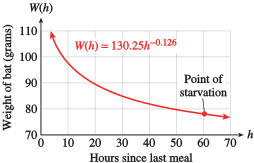
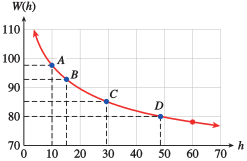
Small animals such as bats cannot survive for long without eating. The graph below shows how the weight, \(W\text{,}\) of a typical vampire bat decreases over time until its next meal, until the bat reaches the point of starvation. The curve is the graph of the function
Use the graph to estimate answers to the following questions: How long can the bat survive after eating until its next meal? What is the bat’s weight at the point of starvation?
Compute the slope of the line segments from point \(A\) to point \(B\text{,}\) and from point \(C\) to point \(D\text{.}\) Include units in your answers.
Suppose a bat that weighs \(80\) grams consumes \(5\) grams of blood. How many hours of life does it gain? Suppose a bat that weighs \(97.5\) grams gives up a meal of \(5\) grams of blood. How many hours of life does it forfeit?
Vampire bats sometimes donate blood (through regurgitation) to other bats that are close to starvation. Suppose a bat at point \(A\) on the curve donates \(5\) grams of blood to a bat at point \(D\text{.}\) Explain why this strategy is effective for the survival of the bat community.
The graphs of power functions \(y = x^{m/n}\text{,}\) where \(m/n\) is positive, are all increasing for \(x\ge 0\text{.}\) If \(m/n\gt 1\text{,}\) the graph is concave up. If \(0 \lt m/n \lt 1\text{,}\) the graph is concave down.
During a flu epidemic in a small town, health officials estimate that the number of people infected \(t\) days after the first case was discovered is given by
\begin{equation*}
I (t) = 50 t^{3/5}
\end{equation*}
Make a table of values for \(I (t)\) on the domain \(0\le t\le 20\text{.}\) What is the range of the function on that domain?
The research division of an advertising firm estimates that the number of people who have seen their ads \(t\) days after the campaign begins is given by the function
\begin{equation*}
N (t) = 2000 t^{5/4}
\end{equation*}
Make a table of values for \(N (t)\) on the domain \(0\le t\le 20\text{.}\) What is the range of the function on that domain?
A brewery wants to replace its old vats with larger ones. To estimate the cost of the new equipment, the accountant uses the \(0.6\) rule for industrial costs, which states that the cost of a new container is approximately \(N = Cr^{0.6}\text{,}\) where \(C\) is the cost of the old container and \(r\) is the ratio of the capacity of the new container to the old one.
If an old vat cost $\(5000\text{,}\) graph \(N\) as a function of \(r\text{.}\)
If a quantity of air expands without changing temperature, its pressure, in pounds per square inch, is given by \(P = kV^{-1.4}\text{,}\) where \(V\) is the volume of the air in cubic inches and \(k = 2.79\times 10^4\text{.}\)
In the 1970s, Jared Diamond studied the number of bird species on small islands near New Guinea. He found that larger islands support a larger number of different species, according to the formula
\begin{equation*}
S = 15.1A^{0.22}
\end{equation*}
where \(S\) is the number of species on an island of area \(A\) square kilometers. (Source: Chapman and Reiss, 1992)
How many species of birds would you expect to find on Manus Island, with an area of \(2100\) square kilometers? On Lavongai, whose area is \(1140\) square kilometers?
The drainage basin of a river channel is the area of land that contributes water to the river. The table gives the lengths in miles of some of the world’s largest rivers and the areas of their drainage basins in square miles. (Source: Leopold, Wolman, and Miller 1992)
Explain how the value of \(p\) in the allometric equation determines the shape of the graph. Consider the cases \(p\gt 1\text{,}\)\(0\lt p\lt 1\text{,}\) and \(p\lt 0\text{.}\)
A good-sized brown bear weighs about \(280\) kilograms, twice the weight of a dolphin. Calculate the ratio of the brain mass of a brown bear to that of a dolphin.
The gourd species Tricosanthes grows according to the formula \(L = ad^{2.2}\text{,}\) where \(L\) is its length and \(d\) is its width. The species Lagenaria has the growth law \(L = ad^{0.81}\text{.}\) (Source: Burton, 1998)
By comparing the exponents, predict which gourd grows into a long, thin shape, and which is relatively fatter. Which species is called the snake gourd, and which is the bottle gourd?
As a fiddler crab grows, one claw (called the chela) grows much faster than the rest of the body. The table shows the mass of the chela, \(C\text{,}\) versus the mass of the rest of the body, \(b\text{,}\) for a number of fiddler crabs. (Source: Burton, 1998)
As the body mass of a fiddler crab doubles from \(100\) mg to \(200\) mg, by what factor does the mass of its chela increase? As the body mass doubles from \(200\) mg to \(400\) mg?
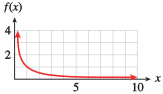
The climate of a region has a great influence on the types of animals that can survive there. Extreme temperatures create difficult living conditions, so the diversity of wildlife decreases as the annual temperature range increases. Along the west coast of North America, the number of species of mammals, \(M\text{,}\) is approximately related to the temperature range, \(R\text{,}\) (in degrees Celsius) by the function \(M = f (R) = 433.8R^{-0.742}\text{.}\) (Source: Chapman and Reiss, 1992)
Graph the function for temperature ranges up to \(30\degree\)C.
If \(50\) different species are found in a certain region, what temperature range would you expect the region to experience? Label the corresponding point on your graph.
Evaluate the function to find \(f (9)\text{,}\)\(f (10)\text{,}\)\(f (19)\text{,}\) and \(f (20)\text{.}\) What do these values represent? Calculate the change in the number of species as the temperature range increases from \(9\degree\)C to \(10\degree\)C and from \(19\degree\)C to \(20\degree\)C. Which \(1\degree\) increase results in a greater decrease in diversity? Explain your answer in terms of slopes on your graph.
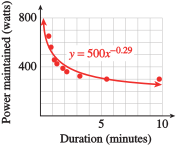
A bicycle ergometer is used to measure the amount of power generated by a cyclist. The scatterplot shows how long an athlete was able to sustain various levels of power output. The curve is the graph of \(y = 500x^{-0.29}\text{,}\) which approximately models the data. (Source: Alexander, 1992)
In 1979, a remarkable pedal-powered aircraft called the Gossamer Albatross was successfully flown across the English Channel. The flight took \(3\) hours. According to the equation, what level of power can be maintained for \(3\) hours?
The Gossamer Albatross needed \(250\) watts of power to keep it airborne. For how long can \(250\) watts be maintained according to the given equation?
Investigation 3.1 at the start of this chapter gives data for the pressure inside April and Tolu’s balloon as a function of its diameter. As the diameter of the balloon increases from \(5\) cm to \(20\) cm, the pressure inside decreases. Can we find a function that describes this portion of the graph?
Pressure is the force per unit area exerted by the balloon on the air inside, or \(P = \dfrac{F}{A}\text{.}\) Because the balloon is spherical, its surface area, \(A\text{,}\) is given by \(A = \pi d^2\text{.}\) Because the force increases as the balloon expands, we will try a power function \(F = kd^p\text{,}\) where \(k\) and \(p\) are constants, and see if this fits the data. Combine the three equations, \(P = \dfrac{F}{A}\text{,}\)\(A = \pi d^2\text{,}\) and \(F = kd^p\text{,}\) to express \(P\) as a power function of \(d\text{.}\)
Use your calculator’s power regression feature to find a power function that fits the data. Graph the function \(P = 211d^{-0.7}\) on top of the data. Do the data support the hypothesis that \(P\) is a power function of \(d\text{?}\)
where \(m\) is measured in grams and \(I\) is in days. (Source: Burton, 1998)
Calculate the incubation time (to the nearest day) for the wren, whose eggs weigh about \(2.5\) grams, and the greylag goose, whose eggs weigh \(46\) grams.
During incubation, birds’ eggs lose water vapor through their porous shells. The rate of water loss from the egg is also a function of its mass, and it appears to follow the rule
in grams per day. Combine the functions \(I(m)\) and \(W(m)\) to calculate the fraction of the initial egg mass that is lost during the entire incubation period.
Predict the daily oxygen consumption per gram of a herring gull’s eggs, given that their incubation time is \(26\) days. (The actual value is \(11\) milliliters per day.)
Kepler’s law gives a relation between the period, \(p\text{,}\) of a planet’s revolution, in years, and its average distance, \(a\text{,}\) from the sun:
\begin{equation*}
p^2 = Ka^3
\end{equation*}
where \(K = 1.243\times 10^{-24}\text{,}\)\(a\) is measured in miles, and \(p\) is in years.
Solve Kepler’s law for \(p\) as a function of \(a\text{.}\)