The numbers associated with points on a number line are called the real numbers. The set of real numbers is denoted by \(\mathbb{R}\text{.}\) You are already familiar with several types, or subsets, of real numbers:
The set \(\mathbb{N} \) of natural, or counting numbers, as its name suggests, consists of the numbers \(1, 2, 3, 4 , \ldots ,\) where "\(\ldots\)" indicates that the list continues without end.
A number that can be expressed as the quotient of two integers \(\dfrac{a}{b} \) where \(b\ne 0\text{,}\) is called a rational number. The integers are rational numbers, and so are common fractions. Some examples of rational numbers are \(5, -2, 0, \dfrac{2}{9} , \sqrt{16},\) and \(\dfrac{-4}{17} \text{.}\) The set of rational numbers is denoted by \(\mathbb{Q} \text{.}\)
Some real numbers cannot be written in the form \(\dfrac{a}{b} \) , where \(a\) and \(b\) are integers. For example, the number \(\sqrt{2} \) is not equal to any common fraction. Such numbers are called irrational numbers. Examples of irrational numbers are \(\sqrt{15}, \pi, \) and \(-\sqrt[3]{7} \text{.}\)
The decimal form of an irrational number never terminates, and its digits do not follow a repeating pattern, so it is impossible to write down an exact decimal equivalent for an irrational number. However, we can obtain decimal approximations correct to any desired degree of accuracy by rounding off. A graphing calculator gives the decimal representation of \(\pi\) as \(3.141592654\text{.}\) This is not the exact value of \(\pi\text{,}\) but for most calculations it is quite adequate.
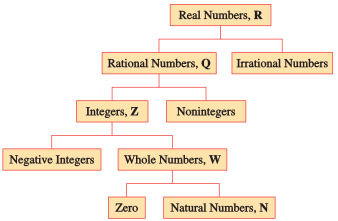
The subsets of the real numbers are related as shown in Figure A.113. Every natural number is also a whole number, every whole number is an integer, every integer is a rational number, and every rational number is real. Also, every real number is either rational or irrational.
The real numbers have several useful properties governing the operations of addition and multiplication. If \(a\text{,}\)\(b\text{,}\) and \(c\) represent real numbers, then each of the following equations is true:
\(\displaystyle \begin{aligned}[t]
\amp a + b = b + a \amp\amp\hphantom{blankblank}\blert{\text{Commutative properties}}\\
\amp ab = ba
\end{aligned}\)
These properties do not mention subtraction or division. But we can define subtraction and division in terms of addition and multiplication. For example, we can define the difference \(a-b\) as follows:
\begin{equation*}
a - b = a + (-b)
\end{equation*}
where \(-b\text{,}\) the additive inverse (or opposite) of \(b\text{,}\) is the number that satisfies
\begin{equation*}
b + (-b) = 0
\end{equation*}
Similarly, we can define the quotient \(\dfrac{a}{b}\text{:}\)
Real numbers obey properties about order, that is, properties about inequalities. The familiar inequality symbols, \(\lt\) and \(\gt\text{,}\) have the following properties:
If \(a\) and \(b\) are any real numbers, then one of three things is true:
\begin{equation*}
a \lt b, ~~\text{ or }~~ a\gt b, ~~\text{ or }~~ a = b
\end{equation*}